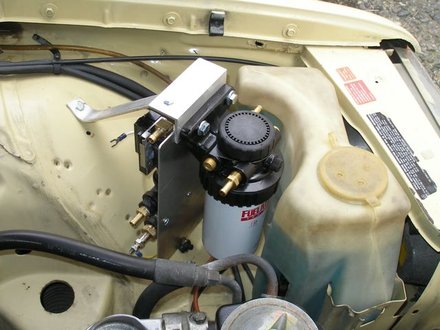
Our basic STC 100 (Single Tank Conversion) it not like any other kit on the market. It is simple in design, trouble free, easy to install and very affordable. Due to the unique design of the early Mercedes diesel engines, we believe they are better suited for single tank conversions than any other diesel engine ever built. In fact, these are the only engines we would ever consider running on a single tank conversion. Unless you live in the cold north and desire to run on 100 percent veggie year round, we believe a single tank conversion is more than adequate for most users. It is much simpler to install, simpler to use, and less prone to trouble (especially problems caused by operator error).


Problem & Solution
Common among these chassis:
Contrary to first impressions, you can run our STC 100 (Single Tank Conversion) system anywhere. When it gets close to freezing and below, all you have to do is blend the SVO with diesel or biodiesel or switch to running on straight diesel.
The following questions and answers should help to clarify any questions you have regarding this conversion:
QUESTIONS AND ANSWERS:
Q. I am a little confused. What is the main difference between a STC (Single Tank Conversion) and a DTC (Dual Tank Conversion) that others offer for sale ?
Answer: An STC only uses the factory fuel tank. That tank alone holds the straight vegetable oil, biodiesel or diesel. Viscosity of the fuel is lowered by blending the fuels together. Since there is only one tank both installation and operation are simple. The DTC uses two fuel tanks AND adds extra heat to the back end of the system. That extra heat reduces viscosity of the fuel and when it gets really cold, you can switch to your secondary tank to shut down and start up on diesel or biodiesel. A DTC conversion has many more things to install and more wiring and plumbing to complete. Operation is more complicated as you will have dash switches to remember how to operate properly!
Q. I like the price and simplicity of the STC. What do I have to do to operate the STC when winter comes?
Answer: We operate a number of STC conversions in our own diesels here in the Pacific Northwest. It does not get as cold here as it does in the midwest or back east, but this past winter we did have temperatures down to 0 degrees F. We typically run on straight veggie from March to late November. Our unique electric boost heat chamber allows us to start up on straight veggie down to about 38 degrees F. When the temperature gets down below that we start blending diesel fuel into the tank. At first 20 percent is enough to reduce viscosity. When it gets down to below 30 degrees F we start adding 50 percent diesel to the vegetable oil. From 20 to 25 degrees F we add 70 to 80 percent diesel to the mix. When it gets below 20 we found it best to switch to running on straight diesel. As far as system operation, nothing needs to change until you switch to running on straight diesel. When that happens you will need to open the hood, turn off the electric boost heater, and turn the valve to the return fuel position. So you can see that switching back and forth between different fuel sources is very easy. You can run on straight diesel or biodiesel anytime you can not find or you run out of SVO!
Q. Why is your kit so much more affordable than other kits on the market?
The main reason is we offer what is called a builders kit which requires you to build some of the components and put it all together. Your willingness to do some of the work saves you money. The other reason for our great value is our sourcing ability. We can get the very best pricing through volume purchasing and pass it on to our customers.
Q. Are there any performance upgrades I can add to the STC 100 kit for cold weather operations?
Answer: We have one upgrade we recommend for the STC 100 to increase power and promote ease of starting. This is even more important if you live in a colder climate. Our conversion will work without this upgrade in warmer climates, but if your budget allows it and you want better acceleration, better mileage, quicker fuel filter changes, and longer filter life we highly recommend the fuel boost pump add-on.
Q. If I decide to go with the STC 100 is there anyway to add the performance boost pump later?
Answer: The answer to that question is a resounding yes. Our aft mounted electric boost pump can be added anytime to help move the thick oil up through the steel fuel line to the engine compartment, increase fuel pressure to the injection pump, increase filter life, and greatly speed the air bleeding process after filter changes or other system maintenance (highly recommended).
Q. What DTC (dual tank conversion) kits do you offer?
Answer: We no longer offer DTC upgrade kits. They proved to be too time consuming to put together. They are also much more complicated to install and operate. We decided it was best to put our energies elsewhere. Since we are such a fan of STC operations for Mercedes ( due to simplicity and reliability) a decision was made to focus on that product line.
Q. Do you have any more written information about what is required to converting to SVO?
Answer: Yes, I have written a number of specific manuals to cover almost all questions people might have about converting. If you would like more details about the basics of conversion see my manual - An Introduction to SVO Conversions for Mercedes Diesels. If you want more information about securing a good fuel source read my guide- Collecting and Filtering Waste Vegetable Oil. If you are interested in the more technical aspects of conversion see - Advanced SVO Theory and Operations. And finally if you want to locate and purchase a good candidate for conversion you must read my manual - Mercedes Diesel Buyers Survival Guide. This alone could save you hundreds and possibly thousands of dollars!
Q. What does Kent personally recommend?
Answer: He personally believes that EVERY conversion should have an aux. fuel boost pump at the back end of the system. He has had and have heard of SO many performance increases by just adding this fuel pump that we have all become real believers. Unfortunately, many do not want to pay for the cost of this pump. If you opt to go without it to start, keep in mind this fuel pump can be added at anytime in the future. The fuel pump increases fuel pressure to your engine driven lift pump- thus increasing usable filter life, smoother idle at startup, and in many cases increasing horsepower by 10 to 20 percent. With all Kent's experiences with different types of conversions just having this pump to bleed the air out of the fuel system is more than enough to make it worth it for him! NOTE for you 60x engine owners: If you have one of the newer 601, 602, or 603 diesels with the self priming lift pump I believe our boost pump is a MUST. When those self priming lift pumps age they have a very hard time pulling veggie oil up to the engine compartment when the temp of the oil is below 70 degrees F.
Even if you only run diesel fuel this is one of the best performance upgrades you can do on your diesel. Read more under related products below:
Q. Why don't you use electric switching valves like everyone else?
Answer: Seven years of experience has shown us a few things. The more complex the system, the more potential for problems. Electric valves do fail and when they do, they don't really let you know right away. People also forget or get confused about switch positions inside the car - especially if they have not driven the car in a long time or you are letting someone else drive the car! A brass manual three-way valve does not fail and you can visually SEE the fuel routing position. Granted, you have to open the hood to change the valve position, but in STC (single tank) operations valve position only needs to be changed when replacing filters or running on straight diesel fuel. Opening the hood and switching it manually is a small price to pay for year-after-year reliable operation.
Q. Can you assure me your kit will provide me with years of reliable and hassle free operation?
Answer: I often receive emails from people who want a conversion that is 100 percent reliable and totally hassle free. Unfortunately, that does not exist. If someone tells you it does, they are not being honest. You need to have your wits about you. There are hassles involved, there is a learning curve to go through, and remember you are adding a non-factory fuel system that if not installed or maintained properly could cause you problems and even leave you stranded on the side of the road. Running straight vegetable oil in a diesel engine is still considered - experimental. The fuel is free but there is still no "free lunch." On the flip side, if done properly a conversion can be a very rewarding and even profitable experience - and you will love being the hit of any party or gathering when the subject turns to running on free fuel!
Q. You mention problems. What kind of problems might I run into when converting my diesel to run on SVO / WVO.
Answer: Most problems encountered will be related to one or more of the following:
1. Improper installation or operation of the kit. This usually translates into incorrect hose plumbing or wiring connections. When installing your kit you must read ALL instructions very carefully and double check your work. That will avoid 90 percent of all installation problems. The other 10 percent might be due to a malfunctioning component or improper operation of the valves. Once your installation is ironed out all future problems will be somehow related to the following three key factors in this order.
2. Air in the filters and fuel lines. This happens at installation and anytime you change a filter or open up your system for maintenance. You must make sure ALL air is out of the system. And just because your engine starts that does not mean you don't have air!. You can not believe how many times users have driven off after a filter change only to have the car quit 3 to 5 miles down the road. After filter changes, run the car for ten minutes with fuel return on return mode. Don't take off on a long trip right after installation or service.
3. Plugged fuel filter(s). Filter life is related directly to the cleanliness and quality of the oil you put in your tank. They can last 500 miles or they can last 10,000 miles. When you start to experience a loss of power it most likely means your filter is plugging up. Replacement filters are cheap. Don't try to push them to the max and ALWAYS carry a spare in the trunk.
4. Poorly tuned or worn engine/engine components. Converting your diesel to run on veggie oil does not make mechanical problems go away. The requirements for an efficient and reliable conversion are a healthy and well tuned engine. If not, then converting to veggie might just give you loss of power, poor fuel economy, excess smoke and harder starting. The key engine factors that might cause this are:
- Valves out of adjustment
- Poor engine compression
- Internal engine timing off (usually due to stretched timing chain)
- Badly worn fuel injectors or injector coking (partially due to ill-tuned engine)
- Worn injection pump / delivery valves
- Badly worn engine driven lift pump
- Lean fuel mixture at injection pump
- Partially plugged fuel tank screen
- Plugged air filter
- Exhaust system restriction (plugged muffler(s))
- Weak or burnt glow plugs
Q. What are the key ongoing maintenance issues I will have to deal with when running SVO?
Answer: From our experience of running our own diesels on SVO over the past four years here is what you should expect to have to deal with. 1. Fuel filters will need regular changing. Always carry spare elements in your trunk along with any tools needed to change them. 2. Fuel injectors will need routine cleaning to remove the coking (hard crusting) from the tips. I recommend they be removed and cleaned every 12,000 miles. I now offer an instruction manual and injector tool cleaning kit to help you accomplish that task. Replace the nozzles of your injectors with the ones we sell from Monark. Their advanced tip design has proven to require less cleaning than those from Bosch. 3. The glow plug pre-chambers will carbon/coke up faster when running SVO. To keep your engine starting smoothly and to extend glow plug life, remove your pencil glow plugs (series glow plug chambers don't have the same problem) every 12,000 miles and ream the pre-chambers out with the glow plug reaming kit we sell on our website. 4. And finally do regular visual inspections on your system. Check for leaking fittings, loose hose clamps, chaffing hoses and tight electrical connections. It is best to find these types of problems before they cause trouble on the road.
Q. What is the best thing I can do to prepare my diesel for conversion?
Answer: Other than the basic tune up requirements listed above and explained in more detail in my - Diesel Performance and Tuning Manual there is one thing I believe is a MUST. if you are converting to SVO and desire the best engine performance and fuel economy I highly recommend you install new Monark Diesel Fuel Injector Nozzles. These nozzles are much more efficient than the original Bosch. They have a finer mist spray pattern and don't have the troublesome tiny cross and longitudinal bore holes in the tip of the nozzle. This new design results in better starts on SVO, less injector coking and required cleaning, more power especially when the engine is cold, and better fuel economy. I have been testing these injectors on my bench tester with cold SVO - and yes - the Bosch nozzles will squirt while the Monarks will still spray a mist even when the oil temperature is close to freezing. I have also designed an inexpensive injector bench tester (under $200) that will allow you to test and balance your SVO fuel injectors on your own. Use our search to find the injector nozzles or kits related specifically to your year and model diesel.